 LSYD
LAISHANG YUDING
Built to your drawing. Specified for where it stands.
A workshop in Chencun, Foshan. Climate-controlled wine cabinets, display systems, stainless trim, glass screens and outdoor planters — every scope costed from your drawing. Indoor work is 304; 316 only where it sits exposed.
Four lines, one sheet, one laser, one team
Quoted from drawingCabinets and trim are not two separate shops. They come off the same cutting process, so grade, bend tolerance and surface grain hold to the same standard across all four lines — which is why joints line up when a project uses cabinets, edging and screens together.
Climate-controlled cabinets
Six interiors: all-steel frame, beech, oak, steel-timber-acrylic, humidor and tea cabinet. Compressor cooling, 12–18°C, condensate evaporates on its own — no drain line to site.
Ambient & display
Five ambient and eight display builds: steel shelves, timber interiors, acrylic open racks, top-and-bottom doors, spot or full weld. 3000K strip lighting included; tax and freight are not.
Architectural trim
Tile trims, U-channels, L-angles, folded T-bars and anti-slip profiles. 97 documented developed widths, 15–140mm, 0.6mm standard, 2.44m per length.
Screens & planters
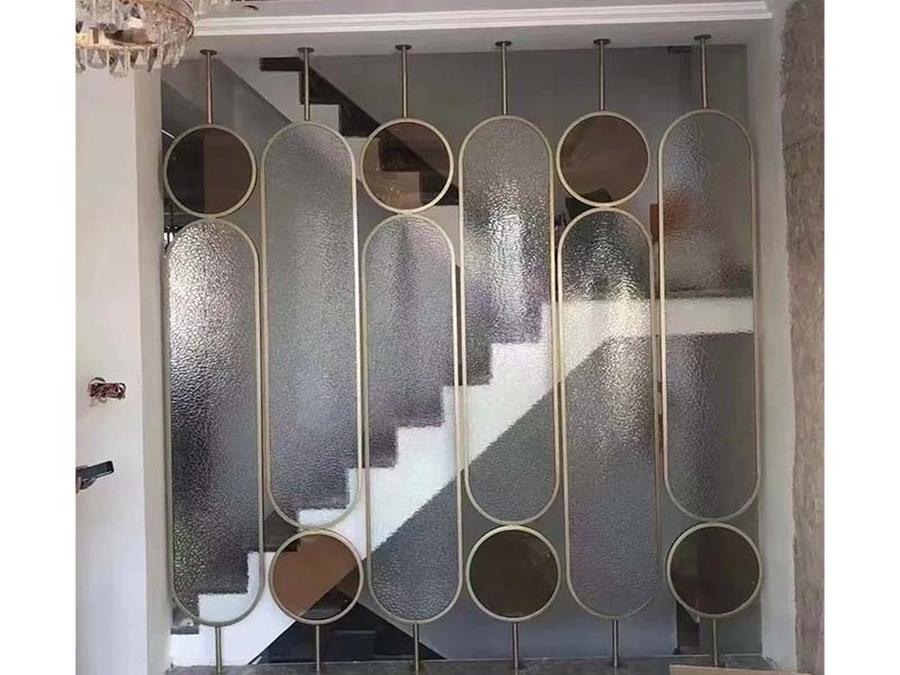
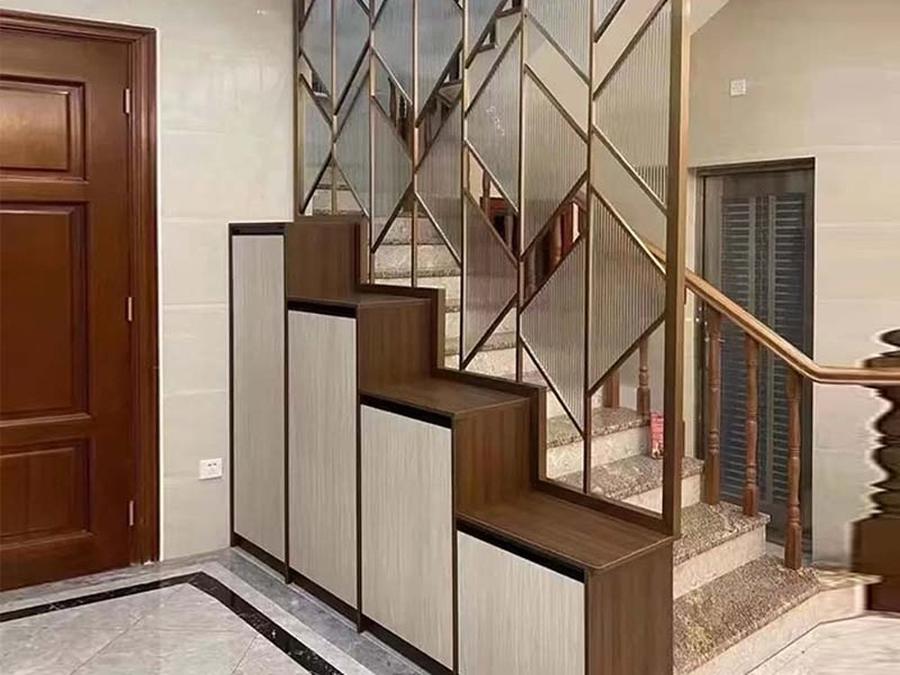
Champagne gold, black titanium or bronze PVD frames; wired, ribbed or glass-block infill. Outdoor planters and unsheltered screens go 316. Size limits are still being consolidated — each job is checked from drawing.
Installed, photographed on site
Foshan · Guangdong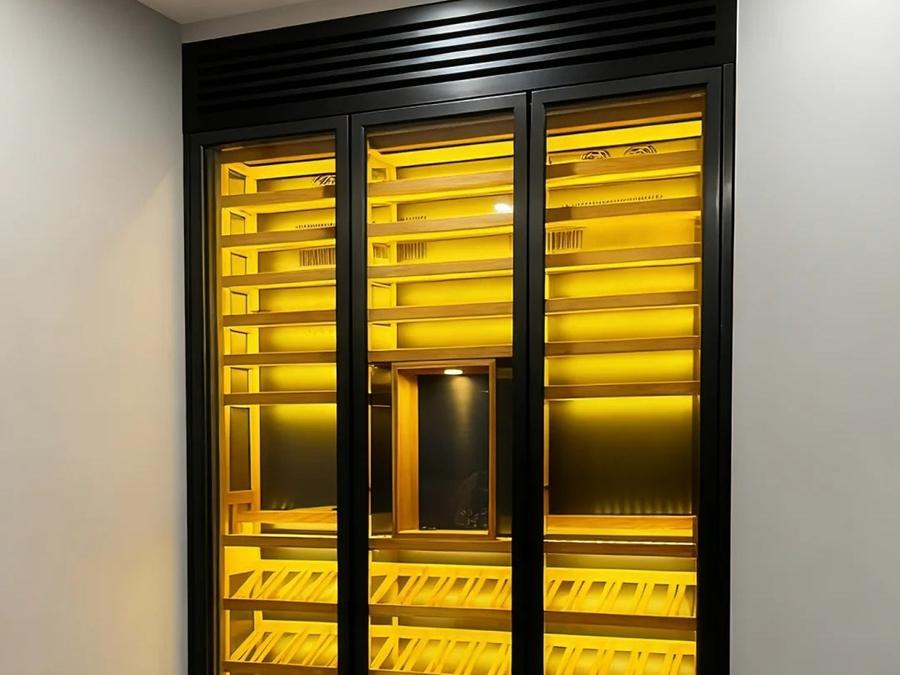
Inside the workshop
Foshan Chencun · in-houseNo staged shots. Four clips shot on a phone — press brake, forming, stock, cutting. Whether cabinet joints line up and whether trim holds its tolerance both come down to what happens in these clips.
Four finishes, one PVD line
Brushed grey, champagne gold, black titanium and bronze all run through the same vacuum PVD process, then a nano anti-fingerprint coat. Most Singapore interiors land on champagne gold: it sits comfortably against timber and stone.
201, 304, 316 — by position, not by country
Grade selectionMost Singapore interior work is 304, and that is what we quote — we do not switch it to 316 to lift the price. 316 goes only where the surface actually collects salt.
| Grade | Density | Where it goes | Where it should not |
|---|---|---|---|
| 201 | 7.93 | Budget indoor scope: soffits, cabinet backs, concealed work | Anything rained on, damp, or salt-exposed |
| 304 | 7.93 | The default for most Singapore interior work: indoor cabinets, kitchens, covered corridors | Facades, parapets, unsheltered sea-facing faces |
| 316 | 7.98 | Only where exposed: outdoor planters, sea-facing facades, unsheltered screens | Indoors behind walls and cover, where it shows no benefit |
Four steps that decide joint width and weathering
ProcessDrop the standard at any step and it only shows once it is on site, when redoing it is no longer cheap.
Laser cutting
Clean edges, developed width calculated once from the drawing — this is where an accurate quote starts.
Bending
Every bend is grooved first: no cracking at the corner, no wrinkles, consistent radius. Whether a trim reads straight is decided here.
Weld & dress
Spot or full weld by use, dressed until the seam disappears before it goes to finishing.
Finishing
Vacuum high-temperature PVD in black titanium, grey steel, champagne gold or bronze, then nano anti-fingerprint.
Quotes start with a drawing, not a price list
The same 2.4m cabinet costs three different numbers depending on interior, depth and shelf material. Send the drawing, sizes, quantity and grade, and the quote comes back itemised rather than as one vague figure.
Climate-controlled · six interior systems
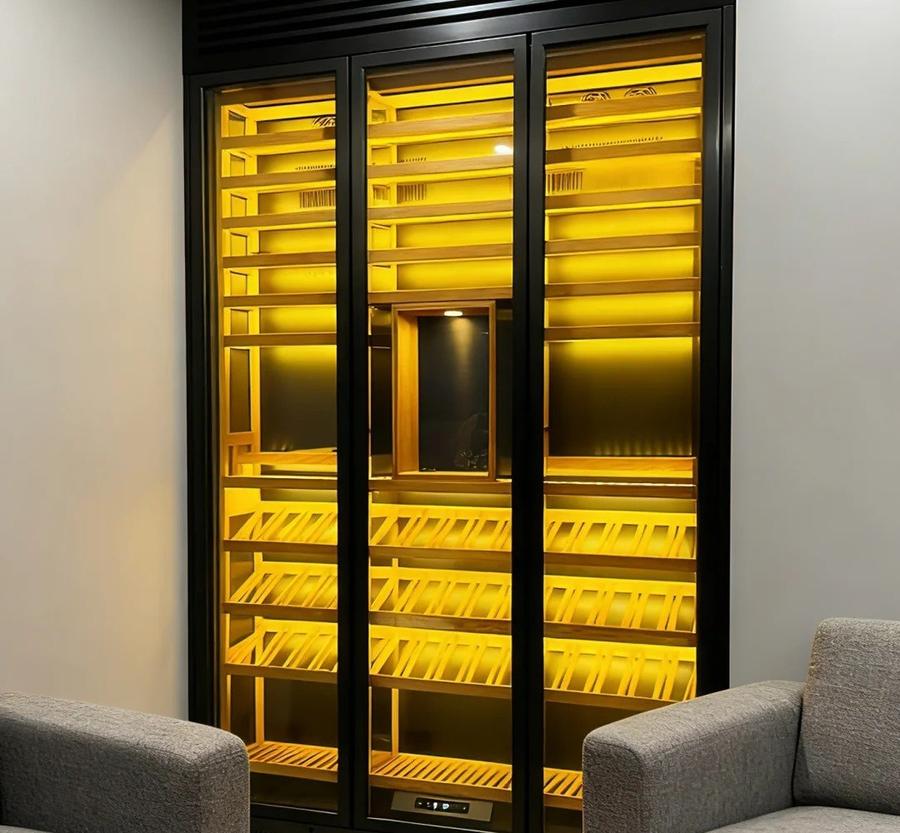
12–18°C / INTEGRATEDOne shell, six interiors — each a different price and a different hand-feel. Steel is damp-proof and easy to wipe; beech and oak read warmer for residential; the steel-timber-acrylic mix suits projects that need light and layering; humidor and tea cabinets add humidity control.
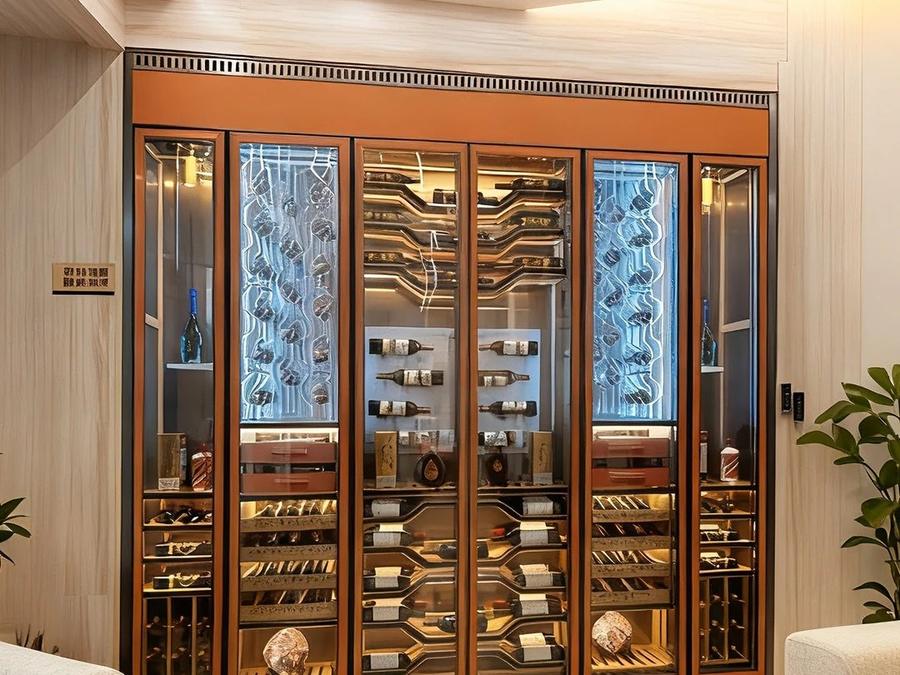
What you can count in this photo
- Six bays, floor to ceiling, vent and skirting finished in the same colour
- Two runs of angled bottle racks, one row of wide drawers in between
- Crate storage at the base, clear height set by the crate
- Strip lighting on separate circuits, top and bottom switched apart
Same shell, different back-panel colour or drawer position — priced by developed area, not by the number of bays.
Adapt this to your sizes| System | Interior | Character | Control |
|---|---|---|---|
| Steel interior | Steel + glass shelves | The default. Damp-proof, odourless, easy to clean — safest for hospitality and hotel rooms | 12–18°C |
| Beech interior | Beech | Warmer and lighter in tone; residential and private cellars | 12–18°C |
| Oak interior | Oak (sample wood optional) | Stronger grain, common on darker schemes; drawers and bottle cradles added per set | 12–18°C |
| Steel + timber + acrylic | Acrylic + steel + oak/beech | Mixed layering; cradles, drawers, hangers, lightboxes and leather edging ship included — for full-wall scopes | 12–18°C |
| Humidor | Spanish cedar | Temperature and humidity controlled together; interior can carry a logo. Cigars live on humidity, not temperature | 12–25°C 55–75% RH |
| Tea cabinet | Beech | Dual control, sample-wood interior; tea rooms and retail display | 12–25°C 55–75% RH |
Cooling can be integrated, packaged or split; compressors from Embraco, Wanbao or Jiaxibella. Condensate evaporates internally with no drain line — decisive on retrofit jobs with no drain point. Costing is by projected area, with a 3 m² floor even below that.
Ambient & display · thirteen structures
201 / 304Ambient lines carry no refrigeration — structure, light and material do the work. Display systems are the retail and club-house type: full steel walls, acrylic grids, open racks. Standard depth is 400mm, deeper runs step up in bands, and dropping the back panel trims cost.
| Structure | Interior / body | Process | Typical use |
|---|---|---|---|
| Ambient · steel interior | Steel + glass shelves | Double-skin side panel with foam; single-skin back | Clubs, restaurants, homes |
| Ambient · oak interior | Oak (beech alternative) | Same body process | Private cellars |
| Ambient · top-bottom doors | Steel + glass shelves | Split top/bottom, concealed handle | Symmetrical elevations |
| Ambient · steel-timber-acrylic | Steel + timber + acrylic | Layered, acrylic transmits light | Full walls with lighting depth |
| Liquor cabinet | Steel | Shelf pitch set to bottle height | Baijiu display |
| Display · steel wall, spot weld | Steel sheet | Clip spot weld — fewer seams, less distortion | Full display walls |
| Display · steel wall, full weld | Steel sheet | Clip full weld — stronger, seamless face | High-spec public space |
| Display · acrylic rack 30/40 | Acrylic grid 30 or 40 | 3000K lighting and remote included | Retail, tasting areas |
| Display · open steel rack | Steel, upright glass shelves | Steel shelves available at an add | Light-detail display |
| Display · open liquor rack | Steel, no back or side | Back and sides optional; full-drop or per-cell doors | Airy small volumes |
| Display · oak in steel body | Steel body + oak interior | Beech alternative | Warm showrooms |
| Display · oak + acrylic | Steel body + oak + acrylic | Acrylic shelves | Boutique retail |
| Niche TV unit | 201 (0.75) / 304 (0.95) | Stock black, gunmetal, titanium; custom 7–10 days powder, 10–15 days plating | Wall niches |
Ambient body: 1.0mm 201 (304 available); 6mm clear tempered door glass, concealed handle and brass-core lock; soft magnetic seal. Display depth under 400mm is standard, 400–500 and 500–600 step up. Quotes exclude tax, crating, freight and installation.
Niche units — four stock formats, packing included
Fourteen options, each priced as a line
Options are never folded into a cabinet unit price — each gets its own line. Change one item and only that line moves, so the quote stays arguable item by item.
Drawing, size, quantity, grade — four things and we can quote
No drawing yet? Photograph the site and mark wall width and floor height; we will issue an elevation for your sign-off.
Stainless trim · 97 profiles
15–140MM DEVELOPEDTrim is the most unforgiving part of this process: one millimetre of developed width shows up as a visible joint on the wall. We price by developed width, thickness, length, finish and packing — five separate lines, so you can see where the money sits.
| Series | Profiles | Developed width | Per length | Where it goes |
|---|---|---|---|---|
| Tile trim | 33 | 32–89mm | 2.44m | Tile-to-wall, skirting, edge closure |
| U-channel | 12 | 15–120mm | 2.44m | Glass channels, panel edging, ceiling trim |
| L-angle | 19 | 16–100mm | 2.44m | External corners, worktop edges, cabinet corners |
| Folded T-bar | 6 | 19–57mm | 2.44m | Dividing joints, expansion joints, facade grid |
| Anti-slip strip | 27 | 20–140mm | 2.44m | Stair nosings, floor safety |
| Flat strip / solid T / solid T with V | Per drawing | Per drawing | 5m coil | Narrow reveals, mirror divisions, edge closure |
The 97 counts the five catalogued series; flat strips and solid T are made per drawing. Every profile is available in 201, 304 and 316.
Why we ask for developed width before price
Two trims both called “10×10” can develop to 30mm or 65mm — double the sheet and a different number of bends. Quoting by the section name alone always leaves someone short. That is why our first column is always developed width.
Grade selection for Singapore, in one page
201 / 304 / 316Short answer: most Singapore interior work uses 304, and that is our standard quote. 316 is for genuinely exposed, sea-facing, salt-collecting surfaces — facades, parapets, outdoor planters, unsheltered screens. 201 is workable for budget indoor scope that stays covered and dry. The point is not that 316 costs more so it must be better: 316 carries 2–3% molybdenum and resists chloride pitting, but in a dry interior that resistance buys nothing.
201 — dry indoor scope only · 430 and galvanised excluded from exterior scope
Four questions we get every week
DECIDE AFTER READINGFinish: one grade, four different lifetimes
WEATHERING ORDER| Finish | Reads as | Use and limits |
|---|---|---|
| Brushed (silver) | Matte, directional grain | The default. Best on fingerprints and scratches; works indoor and outdoor. Our default for Singapore. |
| Mirror 8K / 12K | Highly reflective, cold | Indoors mainly. Outdoors it dulls fast and shows water marks; add anti-fingerprint. |
| Random grain | Speckled, hides marks | High-touch surfaces, lift surrounds, handrails — least likely to show prints. |
| Sandblast | Fine matte, greyish | Works outdoors; on large areas, lock a sample before production to control colour drift. |
| PVD titanium | Black / grey / rose / champagne | Colour is stable, but the substrate is still 304 or 316. A coating does not fix a grade problem. |
| Laser engraving | Pattern, mark, fine line | Keep patterns away from bend radii or they stretch. |
A nano anti-fingerprint coat can follow any finish. Under Singapore humidity it earns its place: less cleaning, longer visual life.
Two we decline
RED LINESStainless iron: not for exterior
430 is ferritic — chromium, no nickel. Cheap, poor corrosion resistance, rusts under moisture. We do not quote 430 for Singapore exterior work, even under price pressure. The savings never cover the failure.
Galvanised: embedded only, never visible
Galvanised parts are powder-coated or embedded out of sight. They are never the visible face: exposed, the zinc layer depletes and edges whiten quickly.
Not sure which grade? Send a photo of the location
We grade by location, not by budget. Where it can be saved we will say so; where it cannot, we will not promise it to win the order.
Enquiry: four inputs, one accurate quote
REPLY WITHIN 24HIt does not need to be elegant. Drawing, size, quantity and grade — with those four the first quote lands close to final. Miss one and the number is a range, with another round of emails behind it.
Direct
Works
No.29-1, 4th Road, Tancun Industrial Zone, Chencun Town,
Shunde District, Foshan, Guangdong, China
Export terms are set per project: ex-works, FOB or CIF. Crating, freight, installation and destination charges appear as separate lines, never folded into the cabinet price.